Measure Information Form
Version 2027A
Measure Information Form
Endovascular thrombectomy (EVT) with a stent retriever is the standard of care for treatment of acute ischemic stroke from anterior circulation proximal large-vessel occlusion (LVO), (Powers W.J., et al., 2018). Reperfusion to TICI 2B/3 should be achieved as early as possible, preferably within 6 hours of stroke onset. The DAWN Clinical Trial Investigators, (Nogueira R.G., et al., 2018), reported the benefits of mechanical thrombectomy in the extended window up to 24 hours of last known well for select patients meeting certain criteria. Time from stroke onset to hospital arrival , initial NIHSS score, prestroke mRS, ASPECTS, patient age, and other factors should be considerations when deciding a treatment window between 6 and 24 hours (Prabhakaran, S., et al., 2026). As with IV alteplase (t-PA), reduced time from symptom onset to reperfusion with EVT is highly associated with better clinical outcomes. Recommendations from the Society of Vascular and Interventional Neurology (SVIN) offer procedural metrics which include time from hospital arrival to groin puncture less than 90 minutes, and time from groin puncture to TICI 2B or better or conclusion of procedure less than 60 minutes (English J.D., et al., 2016).
Type Of Measure: Process Improvement Noted As: Increase in the rateIncluded Populations: As above Excluded Populations: None Data Elements:Denominator Statement: Ischemic stroke patients treated with mechanical endovascular reperfusion therapy for a large vessel occlusion (LVO)
Included Populations:Excluded Populations:
- Discharges with ICD-10-CM Principal Diagnosis Code for ischemic stroke as defined in Appendix A, Table 8.1 for ICD-10 codes, AND
- Patients with documented Mechanical Endovascular Reperfusion Therapy (ICD-10-PCS Principal or Other Procedure Codes as defined in Appendix A, Table 8.1b for ICD-10 codes) OR
- Patients with documented Failed Attempt at Thrombectomy (ICD-10-PCS Principal or Other Procedure Codes as defined in Appendix A, Table 8.1c for ICD-10 codes)
Data Elements:
- Patients less than 18 years of age
- Patients who have a Length of Stay > 120 days
- Patients admitted for Elective Carotid Intervention
- Patients who have an Initial NIHSS Less Than 6
- Patients who have a Delayed Endovascular Rescue Procedure later than 8 hours after hospital arrival (ICD-10-PCS Principal or Other Procedure Codes as defined in Appendix A, Table 8.1b for ICD-10 codes)
- Patients who have a primary cerebral occlusion that is not a large vessel occlusion (LVO)
- Admission Date
- Birthdate
- Delayed Endovascular Rescue Procedure
- Discharge Date
- Elective Carotid Intervention
- Failed Attempt at Thrombectomy
- ICD-10-CM Principal Diagnosis Code
- ICD-10-PCS Other Procedure Codes
- ICD-10-PCS Other Procedure Dates
- ICD-10-PCS Principal Procedure Code
- ICD-10-PCS Principal Procedure Date
- Initial NIHSS Less Than 6
- Site of Primary Vessel Occlusion
- Albers, G. W., Marks, M. P., Kemp, S., Christensen, S., Tsai, J. P., Ortega Gutierrez, S., et al. (2018). Thrombectomy for stroke at 6 to 16 hours with selection by perfusion imaging. The New England Journal of Medicine, 378 (8), 708–718.
- Campbell, B. C. V., Mitchell, P. J., Kleinig, T. J., Dewey, H. M., Churilov, L., Yassi, N., et al. (2015). Endovascular therapy for ischemic stroke with perfusion imaging selection. The New England Journal of Medicine, 372 (11), 1009–1017.
- Demchuk, A. M., Goyal, M., Menon, B. K., Eesa, M., Ryckborst, K. J., Kamal, N., et al. (2015). Endovascular treatment for small core and anterior circulation proximal occlusion with emphasis on minimizing CT to recanalization times (ESCAPE) trial: Methodology. International Journal of Stroke, 10 (3), 429–438.
- English, J. D., Yavagal, D. R., Gupta, R., Janardhan, V., Zaidat, O. O., Xavier, A. R., Nogueira, R. G., Kirmani, J. F., & Jovin, T. G. (2015). Mechanical thrombectomy ready comprehensive stroke center requirements and endovascular stroke systems of care: Recommendations from the Endovascular Stroke Standards Committee of the Society of Vascular and Interventional Neurology (SVIN). Interventional Neurology, 4, 138–150.
- Leifer, D., Bravata, D. M., Connors, J. J., III, Hinchey, J. A., Jauch, E. C., Johnston, S. C., Latchaw, R., Likosky, W., Ogilvy, C., Qureshi, A. I., Summers, D., Sung, G. Y., Williams, L. S., & Zorowitz, R. (2011). Metrics for measuring quality of care in comprehensive stroke centers: Detailed follow-up to Brain Attack Coalition comprehensive stroke center recommendations: A statement for healthcare professionals from the American Heart Association/American Stroke Association. Stroke, 42, 853-54.
- Menon, B. K., Saver, J. L., Prabhakaran, S., Reeves, M., Liang, L., Olson, D. W. M., Peterson, E. D., Hernandez, A. F., Fonarow, G. C., Schwamm, L. H., & Smith, E. E. (2012). Risk score for intracranial hemorrhage in patients with acute ischemic stroke treated with intravenous tissue type plasminogen activator. Stroke, 43, 1–9.
- Nogueira, R. G., Jadhav, A. P., Haussen, D. C., Bonafe, A., Budzik, R. F., Bhuva, P., et al. (2018). Thrombectomy 6 to 24 hours after stroke with a mismatch between deficit and infarct. The New England Journal of Medicine, 378 (1), 11–21.
- Powers, W. J., Derdeyn, C. P., Biller, J., Coffey, C. S., Jauch, E. C., Johnston, K. C., Johnston, S. C., Khalessi, A. A., Kidwell, C. S., Meschia, J. F., Ovbiagele, B., & Yavagal, D. R., on behalf of the American Heart Association Stroke Council. (2015). 2015 AHA/ASA focused update of the 2013 guidelines for the early management of patients with acute ischemic stroke regarding endovascular treatment: A guideline for healthcare professionals from the American Heart Association/American Stroke Association. Stroke, 46, 3021–3035.
- Powers, W. J., Rabinstein, A. A., Ackerson, T., Adeoye, O. M., Bambakidis, N. C., Becker, K., Biller, J., et al., on behalf of the American Heart Association Stroke Council. (2018). 2018 guidelines for the early management of patients with acute ischemic stroke: A guideline for healthcare professionals from the American Heart Association/American Stroke Association. Stroke, 49, e10–e11, e26–e30.
- Powers, W. J., Rabinstein, A. A., Ackerson, T., Adeoye, O. M., Bambakidis, N. C., Becker, K., Biller, J., et al. (2019). Guidelines for the early management of patients with acute ischemic stroke: 2019 update to the 2018 guidelines for the early management of acute ischemic stroke—A guideline for healthcare professionals from the American Heart Association/American Stroke Association. Stroke, 50 (12), e344–e418.
- Prabhakaran, S., Gonzalez, N. R., Zachrison, K. S., Adeoye, O., Alexandrov, A. W., Ansari, S. A., Chapman, S., Czap, A. L., Dumitrascu, O. M., Ishida, K., Jadhav, A. P., Johnson, B., Johnston, K. C., Khatri, P., Kimberly, W. T., Lee, V. H., Leslie-Mazwi, T. M., Mac Grory, B., Madsen, T. E., Menon, B., Mistry, E. A., Park, S., Parker, S., Pérez de la Ossa, N., Reeves, M., Saiz, T., Scott, P. A., Schwartzberg, D., Sheth, S. A., Sporns, P. B., Times, S., Tjoumakaris, S., Wolfe, S. Q., & Yaghi, S.; Peer Review Committee Collaborators. (2026). 2026 guideline for the early management of patients with acute ischemic stroke: A guideline from the American Heart Association/American Stroke Association. Stroke. Advance online publication. https://doi.org/10.1161/STR.0000000000000513
- Pride, G. L., Fraser, J. F., Gupta, R., Alberts, M. J., Rutledge, J. N., Fowler, R., et al. (2016). Prehospital care delivery and triage of stroke with emergent large vessel occlusion (LVO): Report of the Standards and Guidelines Committee of the Society of NeuroInterventional Surgery (SNIS). Journal of NeuroInterventional Surgery, 0, 1–11.
- Saver, J. L., Goyal, M., Bonafe, A., Diener, H.-C., Levy, E. I., Pereira, V. M., et al. (2015). Stent retriever thrombectomy after intravenous t PA vs. t PA alone in stroke. The New England Journal of Medicine, 372 (24), 2285–2295.
CSTK-11: Algorithm Narrative
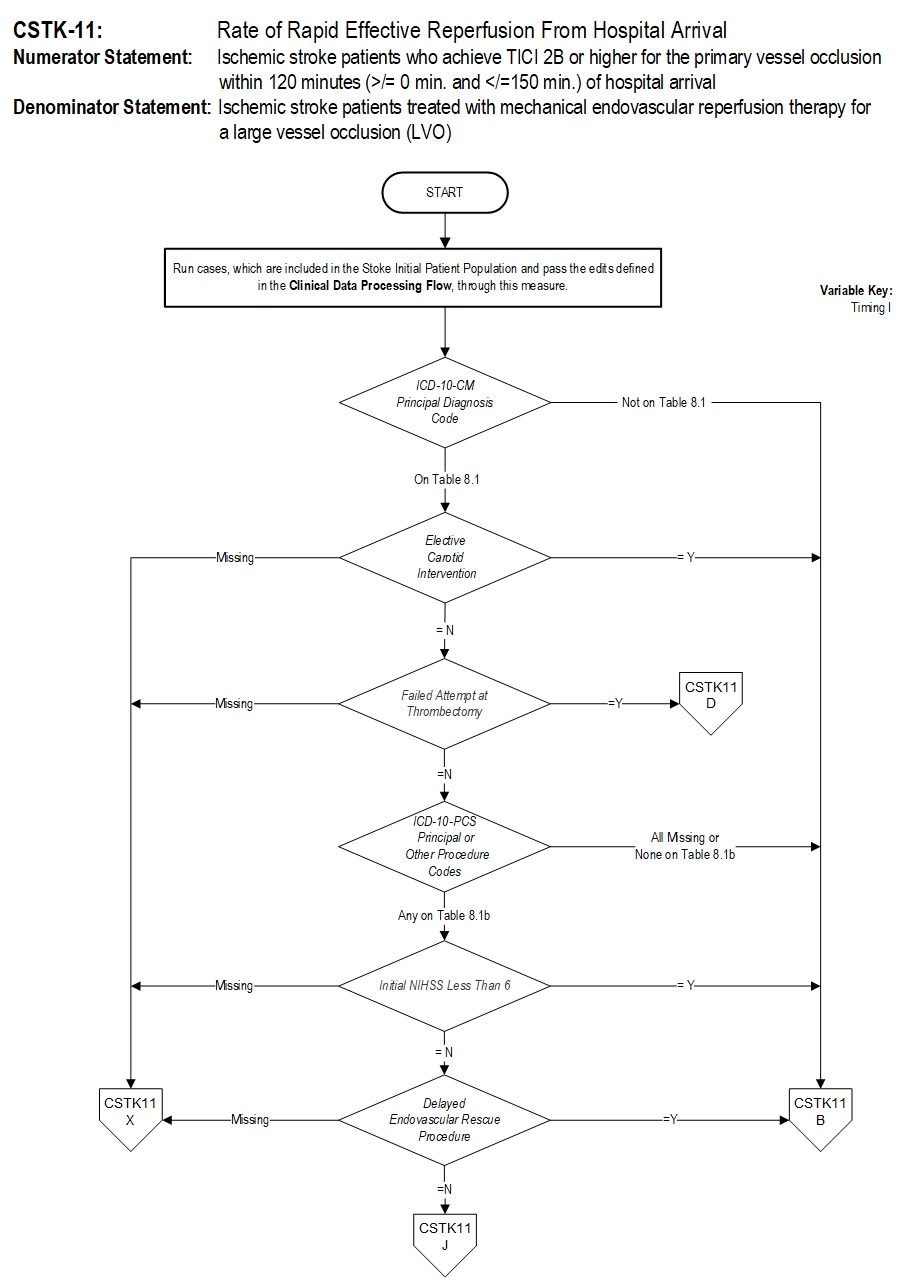
CSTK-11: Rate of Rapid Effective Reperfusion From Hospital Arrival Numerator: Ischemic stroke patients who achieve TICI 2B or higher for the primary vessel occlusion within 120 minutes (greater than or equal to 0 minutes and less than or equal to 150 minutes) of hospital arrival.
Denominator: Ischemic stroke patients treated with mechanical endovascular reperfusion therapy for a large vessel occlusion (LVO).
Variable Key: Timing I
1. Start processing. Run cases, which are included in the Comprehensive Stoke Initial Patient Population and pass the edits defined in the Clinical Data Processing Flow, through this measure.
2. Check ICD-10-CM Principal Diagnosis Code.
- If all ICD-10-CM Principal Diagnosis codes are not on Table 8.1, the case will proceed to a Measure Category Assignment of B and will not be in the Measure Population. Stop processing.
- If at least one of the ICD-10-CM Principal Diagnosis codes is on Table 8.1, continue processing and proceed to check Elective Carotid Intervention.
- If Elective Carotid Intervention is missing, the case will proceed to a Measure Category Assignment of X and will be rejected. Stop processing.
- If Elective Carotid Intervention equals Y, the case will proceed to a Measure Category Assignment of B and will not be in the Measure Population. Stop processing.
- If Elective Carotid Intervention equals N, continue processing and proceed to check Failed Attempt at Thrombectomy.
- If Failed Attempt at Thrombectomy is missing, the case will proceed to a Measure Category Assignment of X and will be rejected. Stop processing.
- If Failed Attempt at Thrombectomy equals Y, the case will proceed to a Measure Category Assignment of D and will be in the Measure Population. Stop processing.
- If Failed Attempt at Thrombectomy equals N, continue processing and proceed to check ICD-10-PCS Principal or Other Procedure Codes.
- If all ICD-10-PCS Principal or Other Procedure Codes are not on Table 8.1b, the case will proceed to a Measure Category Assignment of B and will not be in the Measure Population. Stop processing.
- If at least one of the ICD-10-PCS Principal or Other Procedure Codes is on Table 8.1b, continue processing and proceed to check Initial NIHSS Less Than 6.
- If Initial NIHSS Less Than 6 is missing, the case will proceed to a Measure Category Assignment of X and will be rejected. Stop processing.
- If Initial NIHSS Less Than 6 equals Y, the case will proceed to a Measure Category Assignment of B and will not be in the Measure Population. Stop processing.
- If Initial NIHSS Less Than 6 equals N, continue processing and proceed to check Delayed Endovascular Rescue Procedure .
- If Delayed Endovascular Rescue Procedure is missing, the case will proceed to a Measure Category Assignment of X and will be rejected. Stop processing.
- If Delayed Endovascular Rescue Procedure equals Y, the case will proceed to a Measure Category Assignment of B and will not be in the Measure Population. Stop processing.
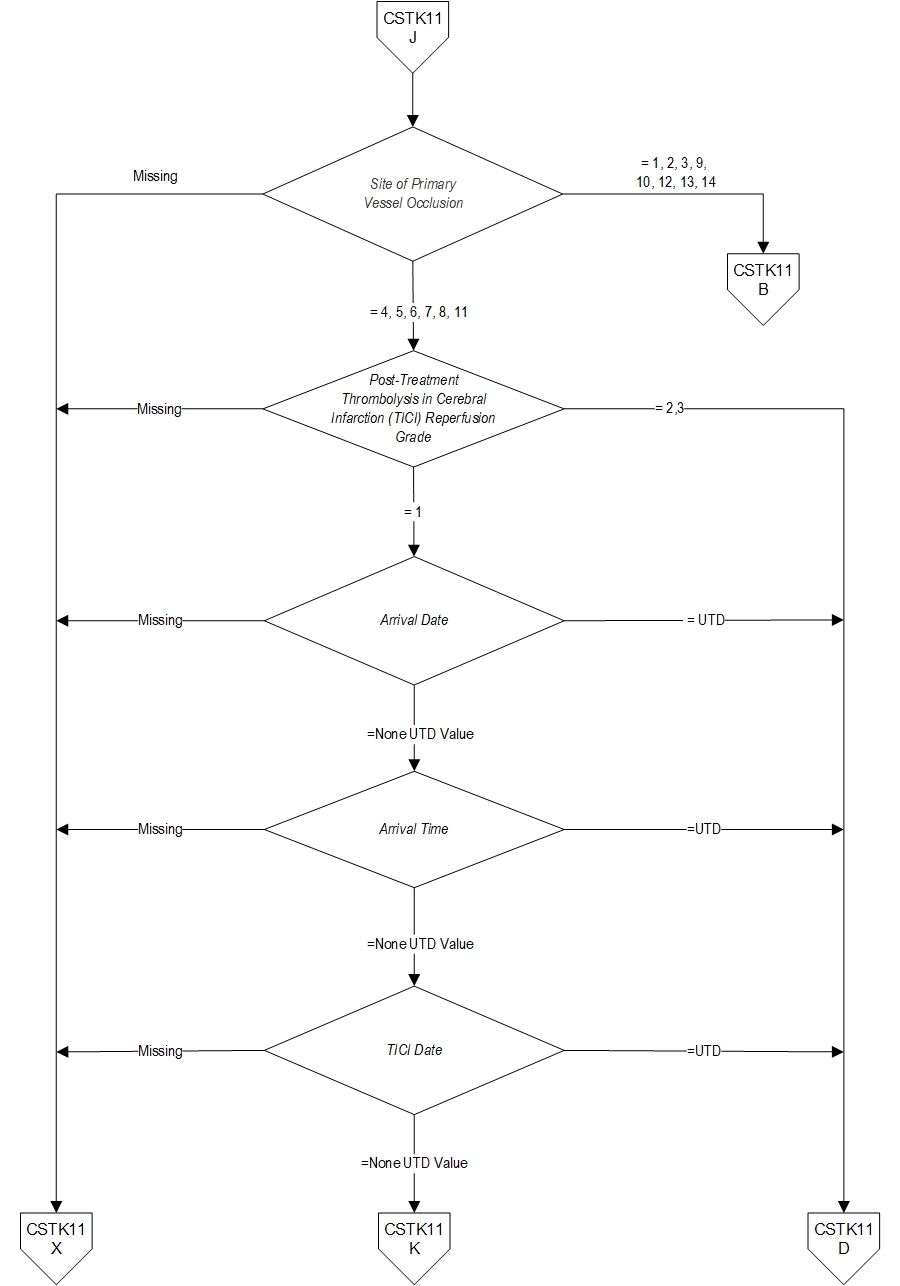
- If Delayed Endovascular Rescue Procedure equals N, continue processing and proceed to check Site of Primary Vessel Occlusion .
- If Site of Primary Vessel Occlusion is missing, the case will proceed to a Measure Category Assignment of X and will be rejected. Stop processing.
- If Site of Primary Vessel Occlusion equals 1, 2, 3, 9, 10, 12, 13 or 14, the case will proceed to a Measure Category Assignment of B and will not be in the Measure Population. Stop processing.
- If Site of Primary Vessel Occlusion equals 4, 5, 6, 7, 8 or 11, continue processing and proceed to check Post-Treatment Thrombolysis in Cerebral Infarction (TICI) Reperfusion Grade.
- If Post-Treatment Thrombolysis in Cerebral Infarction (TICI) Reperfusion Grade is missing, the case will proceed to a Measure Category Assignment of X and will be rejected. Stop processing.
- If Post-Treatment Thrombolysis in Cerebral Infarction (TICI) Reperfusion Grade equals 2 or 3, the case will proceed to a Measure Category Assignment of D and will be in the Measure Population. Stop processing.
- If Post-Treatment Thrombolysis in Cerebral Infarction (TICI) Reperfusion Grade equals 1, continue processing and proceed to check Arrival Date.
- If Arrival Date is missing, the case will proceed to a Measure Category Assignment of X and will be rejected. Stop processing.
- If Arrival Date equals UTD, the case will proceed to a Measure Category Assignment of D and will be in the Measure Population. Stop processing.
- If Arrival Date is Non-UTD value continue processing and proceed to check Arrival Time.
- If Arrival Time is missing, the case will proceed to a Measure Category Assignment of X and will be rejected. Stop processing.
- If Arrival Time equals UTD, the case will proceed to a Measure Category Assignment of D and will be in the Measure Population. Stop processing.
- If Arrival Time is Non-UTD value continue processing and proceed to check TICI Date.
- If TICI Date is missing, the case will proceed to a Measure Category Assignment of X and will be rejected. Stop processing.
- If TICI Date equals UTD, the case will proceed to a Measure Category Assignment of D and will be in the Measure Population. Stop processing.
- If TICI Date is Non-UTD value continue processing and proceed to check TICI Time.
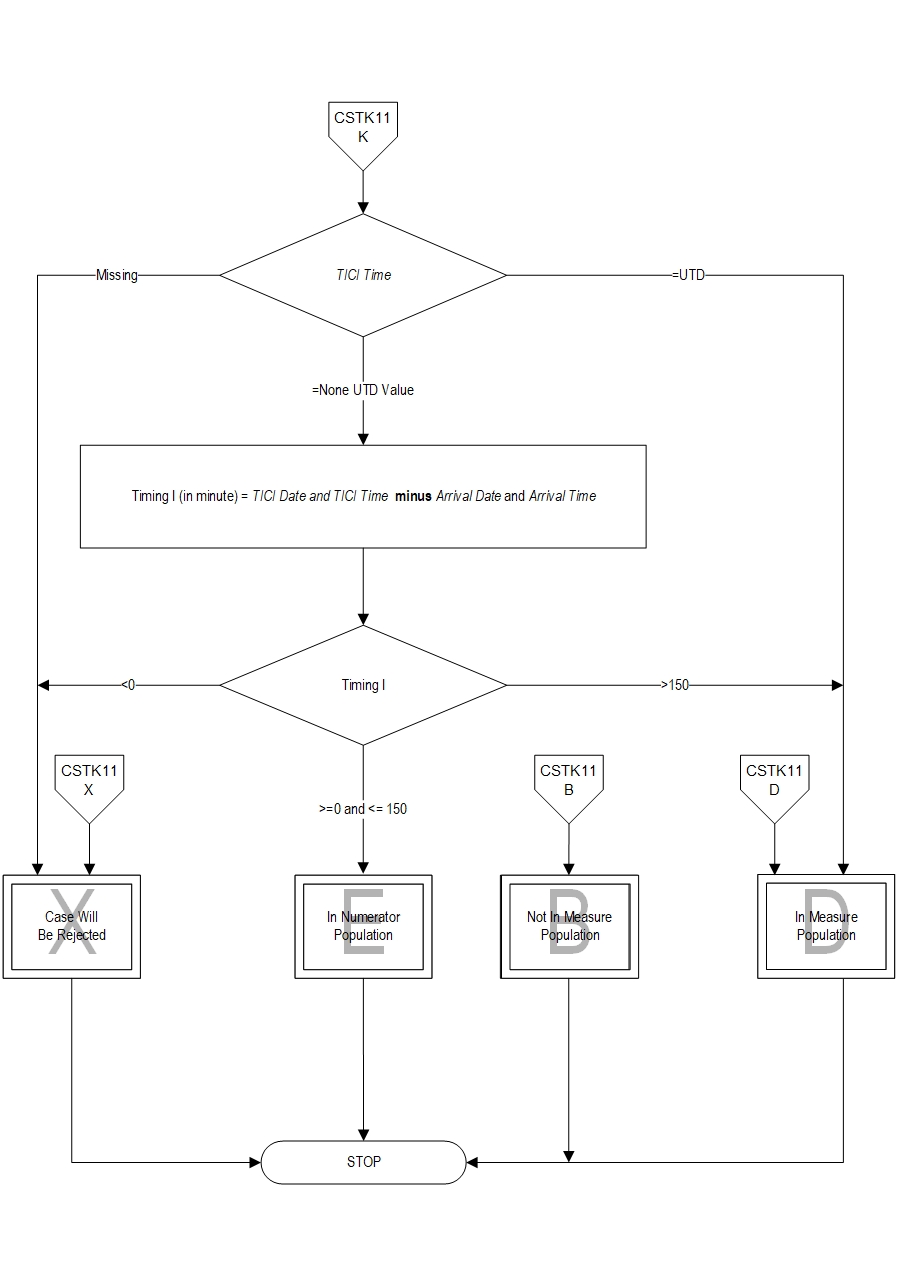
- If TICI Time is missing, the case will proceed to a Measure Category Assignment of X and will be rejected. Stop processing.
- If TICI Time equals UTD, the case will proceed to a Measure Category Assignment of D and will be in the Measure Population. Stop processing.
- If TICI Time is Non-UTD value continue processing and proceed to calculate Timing I.
15. Check Timing I
- If Timing I is less than 0 minutes, the case will proceed to a Measure Category Assignment of X and will be rejected. Stop processing.
- If Timing I is greater than 150 minutes, the case will proceed to a Measure Category Assignment of D and will be in the Measure Population. Stop processing.
- If Timing I is greater than or equal to 0 minutes and less than or equal to 150 minutes, the case will proceed to a Measure Category Assignment of E and will be in the numerator population. Stop processing.
LICENSE FOR USE OF CURRENT PROCEDURAL TERMINOLOGY, FOURTH EDITION (“CPT®”)
CPT® only copyright 2026 American Medical Association. All rights reserved. CPT® is a registered trademark of the American Medical Association.
You, your employees and agents are authorized to use CPT® only as contained in The Joint Commission performance measures solely for your own personal use in directly participating in healthcare programs administered by The Joint Commission. You acknowledge that the American Medical Association (“AMA”) holds all copyright, trademark and other rights in CPT®.
Any use not authorized herein is prohibited, including by way of illustration and not by way of limitation, making copies of CPT® for resale and/or license, transferring copies of CPT® to any party not bound by this Agreement, creating any modified or derivative work of CPT®, or making any commercial use of CPT®. License to use CPT® for any use not authorized herein must be obtained through the American Medical Association, Intellectual Property Services, AMA Plaza, 330 North Wabash Avenue, Suite 39300, Chicago, Illinois 60611-5885. Applications are available at the American Medical Association Web site, www.ama- assn.org/go/cpt.
U.S. Government Rights This product includes CPT® which is commercial technical data, which was developed exclusively at private expense by the American Medical Association, 330 North Wabash Avenue, Chicago, Illinois 60611. The American Medical Association does not agree to license CPT® to the Federal Government based on the license in FAR 52.227-14 (Data Rights - General) and DFARS 252.227-7015 (Technical Data - Commercial Items) or any other license provision. The American Medical Association reserves all rights to approve any license with any Federal agency.
Disclaimer of Warranties and Liabilities. CPT® is provided “as is” without warranty of any kind, either expressed or implied, including but not limited to the implied warranties of merchantability and fitness for a particular purpose. Fee schedules, relative value units, conversion factors and/or related components are not assigned by the AMA, are not part of CPT®, and the (AMA is not recommending their use. The AMA does not directly or indirectly practice medicine or dispense medical services. The responsibility for the content of this product is with The Joint Commission, and no endorsement by the AMA is intended or implied. The AMA disclaims responsibility for any consequences or liability attributable to or related to any use, non-use, or interpretation of information contained or not contained in this product.
This Agreement will terminate upon notice if you violate its terms. The AMA is a third party beneficiary to this Agreement.
Should the foregoing terms and conditions be acceptable to you, please indicate your agreement and acceptance by clicking below on the button labeled “accept”.