Measure Information Form
Version 2027A
Measure Information Form
***Removed from ORYX. Measure will be maintained until further notice.***| Set Measure ID | Performance Measure Name |
|---|---|
SUB-3  |
Alcohol & Other Drug Use Disorder Treatment Provided or Offered at Discharge |
| SUB-3a |
Alcohol & Other Drug Use Disorder Treatment at Discharge |
SUB-3 Patients who are identified with alcohol or drug use disorder who receive or refuse at discharge a prescription for FDA-approved medications for alcohol or drug use disorder, OR who receive or refuse a referral for addictions treatment.
SUB-3a Patients who are identified with alcohol or drug disorder who receive a prescription for FDA-approved medications for alcohol or drug use disorder OR a referral for addictions treatment.
The measure is reported as an overall rate which includes all patients to whom alcohol or drug use disorder treatment was provided, or offered and refused, at the time of hospital discharge, and a second rate, a subset of the first, which includes only those patients who received alcohol or drug use disorder treatment at discharge. The Provided or Offered rate (SUB-3) describes patients who are identified with alcohol or drug use disorder who receive or refuse at discharge a prescription for FDA-approved medications for alcohol or drug use disorder, OR who receive or refuse a referral for addictions treatment. The Alcohol and Other Drug Disorder Treatment at Discharge (SUB-3a) rate describes only those who receive a prescription for FDA-approved medications for alcohol or drug use disorder OR a referral for addictions treatment. Those who refused are not included.
Rationale: Excessive use of alcohol and drugs has a substantial harmful impact on health and society in the United States. About 178,000 people die from excessive alcohol drinking each year and excessive alcohol use is a leading preventable cause of death in the United States (Centers for Disease Control and Prevention [CDC], 2024). Excessive alcohol use costs the US economy billions annually in lost productivity, crime, and healthcare spending (CDC, 2024). Substance use disorder treatment in US emergency departments and inpatient settings reached more than $13 billion dollars in 2017 with alcohol related disorders being the most common (Peterson, 2021).According to the 2024 National Survey on Drug Use and Health (NSDUH), 48.4 million Americans, aged 12 or older, had a substance use disorder (SUD) in the past year (Substance Abuse and Mental Health Services Administration [SAMHSA], 2025). As of 2024, 9.7% of the US population age 12 and older (27.9 million people) had an alcohol use disorder in the past year (SAMHSA, 2025).
Clinical trials have demonstrated that screening and brief interventions, especially prior to the onset of addiction, results in beneficial reductions in alcohol use and reduces costs, and that similar benefits occur for those who are referred to treatment (Tanner-Smith et al., 2021; Barbosa et al., 2020).
Individuals with psychiatric disorders are more likely to have co-occurring substance use disorders. In 2024, among the 14.6 million adults who had a severe mental illness, nearly half (6.9 million people) also had a substance use disorder (SAMHSA, 2025). While there are substantial evidence-based interventions for substance use, few patients receive substance use care: Among the 52.6 million people in 2024 who reported needing substance use treatment in the past year, 3.5% (or 10.2 million people) received substance use treatment (SAMHSA, 2025).
Type Of Measure: Process Improvement Noted As: Increase in the rateSUB-3: The number of patients who received or refused at discharge a prescription for medication for treatment of alcohol or drug use disorder OR received or refused a referral for addictions treatment. SUB-3a: The number of patients who received a prescription at discharge for medication for treatment of alcohol or drug use disorder OR a referral for addictions treatment.
Included Populations: Sub-3Denominator Statement: The number of hospitalized inpatients 18 years of age and older identified with an alcohol or drug use disorder.
Patients who refused a prescription for FDA-approved medication for treatment of an alcohol or drug dependence. Patients who refused a referral for addictions treatment. Sub-3a
Not Applicable Excluded Populations: SUB-3 and SUB-3a
None Data Elements:
Included Populations:Excluded Populations:
- Patients with ICD-10-CM Principal or Other Diagnosis Code for alcohol or drug use disorder listed on Table 13.1 and 13.2
- Patients with a Principal or Other ICD-10-PCS Procedure Code listed on Table 13.3
Data Elements:
- Patients less than 18 years of age
- Patient drinking at unhealthy levels who do not meet criteria for an alcohol use disorder
- Patients who are cognitively impaired
- Patients who expire
- Patients discharged to another hospital
- Patients who left against medical advice
- Patients discharged to another healthcare facility
- Patients discharged to home or another healthcare facility for hospice care
- Patients who have a duration of stay less than or equal to one day or greater than 120 days
- Patients who do not reside in the United States
- Patients receiving Comfort Measures Only documented
Variation may exist in the assignment of ICD-10 codes; therefore, coding practices may require evaluation to ensure consistency.
Measure Analysis Suggestions: Hospitals may wish to analyze data to show patients that refused both a medication prescription and referral and those who refused only one or the other. Sampling: Yes. Yes, please refer to the measure set specific sampling requirements and for additional information see the Population and Sampling Specifications section. Data Reported As: Aggregate rate generated from count data reported as a proportion. Selected References:- Centers for Disease Control and Prevention. (2024). Excessive drinking data & statistics. U.S. Department of Health and Human Services. https://www.cdc.gov/alcohol/excessive-drinking-data/index.html
- Barbosa, C., McKnight-Eily, L. R., Grosse, S. D., & Bray, J. (2020). Alcohol screening and brief intervention in emergency departments: Review of the impact on healthcare costs and utilization. Journal of Substance Abuse Treatment, 117, 108096. https://doi.org/10.1016/j.jsat.2020.108096
- Peterson, C., Li, M., Xu, L., Mikosz, C. A., & Luo, F. (2021). Assessment of annual cost of substance use disorder in US hospitals. JAMA Network Open, 4 (3), e210242. https://doi.org/10.1001/jamanetworkopen.2021.0242
- Substance Abuse and Mental Health Services Administration. (2025). Key substance use and mental health indicators in the United States: Results from the 2024 National Survey on Drug Use and Health (HHS Publication No. PEP25-07-007, NSDUH Series H-60). Center for Behavioral Health Statistics and Quality, Substance Abuse and Mental Health Services Administration. https://www.samhsa.gov/data/data-we-collect/nsduh-national-survey-drug-use-and-health/national-releases
- Tanner-Smith, E. E., Parr, N. J., Schweer-Collins, M., & Saitz, R. (2021). Effects of brief substance use interventions delivered in general medical settings: a systematic review and meta-analysis. Addiction (Abingdon, England), 117 (4), 877–889. https://doi.org/10.1111/add.15674


Algorithm Narrative
SUB-3: Alcohol and Other Drug Use Disorder Treatment Provided or Offered at DischargeNumerator: The number of patients who received or refused at discharge a prescription for medication for treatment of alcohol or drug use disorder OR received or refused a referral for addictions treatment.
Denominator: The number of hospitalized inpatients 18 years of age and older identified with an alcohol or drug use disorder.
Variable key:
Patient Age
Length of Stay
1. Start processing. Run cases, which are included in the Global Initial Patient Population and pass the edits defined in the Clinical Data Processing Flow, through this measure.
2. Calculate Patient Age. Patient Age, in years, is equal to the Admission Date minus the Birthdate. Use the month and day portion of Admission Date and Birthdate to yield the most accurate age. Only cases with valid Admission Date and Birthdate will pass the critical feedback messages into the measure specific algorithms.
3. Check Patient Age
a. If Patient Age is less than 18 years, the case will proceed to a Measure Category Assignment of B for overall rate SUB-3 and will not be in the Measure Population. Continue processing and proceed to Step 15 to Initialize Measure Category Assignment for sub-measure SUB-3a.
b. If Patient Age is equal to or greater than 18 years, continue processing and proceed to calculate of Length of Stay.
4. Calculate Length of Stay. Length of Stay, in days, is equal to the Discharge Date minus the Admission Date.
5. Check Length of Stay
a. If Length of Stay is equal to or less than 1 day, the case will proceed to a Measure Category Assignment of B for overall rate SUB-3 and will not be in the Measure Population. Continue processing and proceed to Step 15 to Initialize Measure Category Assignment for sub-measure SUB-3a.
b. If Length of Stay is greater than 1 day, continue processing and proceed to check Comfort Measures Only.
6. Check Comfort Measures Only
a. If Comfort Measures Only is missing, the case will proceed to a Measure Category Assignment of X for overall rate SUB-3 and will be rejected. Continue processing and proceed to Step 15 to Initialize Measure Category Assignment for sub-measure SUB-3a.
b. If Comfort Measures Only is equal to 1, 2 or 3, the case will proceed to a Measure Category Assignment of B for overall rate SUB-3 and will not be in the Measure Population. Continue processing and proceed to Step 15 to Initialize Measure Category Assignment for sub-measure SUB-3a.
c. If Comfort Measures Only is equal to 4, continue processing and proceed to check Alcohol Use Status.
7. Check Alcohol Use Status
a. If Alcohol Use Status is missing, the case will proceed to a Measure Category Assignment of X for overall rate SUB-3 and will be rejected. Continue processing and proceed to Step 15 to Initialize Measure Category Assignment for sub-measure SUB-3a.
b. If Alcohol Use Status equals 7, the case will proceed to a Measure Category Assignment of B for overall rate SUB-3 and will not be in the Measure Population. Continue processing and proceed to Step 15 to Initialize Measure Category Assignment for sub-measure SUB-3a.
c. If Alcohol Use Status equals 1,2,3,4,5, or 6, continue processing and proceed to check Discharge Disposition.
8. Check Discharge Disposition
a. If Discharge Disposition is missing, the case will proceed to a Measure Category Assignment of X for overall rate SUB-3 and will be rejected. Continue processing and proceed to Step 15 to Initialize Measure Category Assignment for sub-measure SUB-3a.
b. If Discharge Disposition equals 2, 3, 4, 5, 6 or 7, the case will proceed to a Measure Category Assignment of B for overall rate SUB-3 and will not be in the Measure Population. Continue processing and proceed to Step 15 to Initialize Measure Category Assignment for sub-measure SUB-3a.
c. If Discharge Disposition equals 1 or 8, continue processing and proceed to check ICD-10-CM Principal or Other Diagnosis Codes.
9. Check ICD-10-CM Principal or Other Diagnosis Codes
a. If none of ICD-10-CM Principal or Other Diagnosis Codes is on Table 13.1 or 13.2, continue processing and proceed to Step 10 to check ICD-10-PCS Principal or Other Procedure Codes.
b. If any of ICD-10-CM Principal or Other Diagnosis Codes is on Table 13.1 or 13.2, continue processing and proceed to Step 11 to check Referral for Addictions Treatment.
10. Check ICD-10-PCS Principal or Other Procedure Codes
a. If all missing or none of ICD-10-PCS Principal or Other Procedure Codes is on Table 13.3, the case will proceed to a Measure Category Assignment of B for overall rate SUB-3 and will not be in the Measure Population. Continue processing and proceed to Step 15 to Initialize Measure Category Assignment for sub-measure SUB-3a.
b. If any of ICD-10-PCS Principal or Other Procedure Codes is on Table 13.3, continue processing and proceed to check Referral for Addictions Treatment.
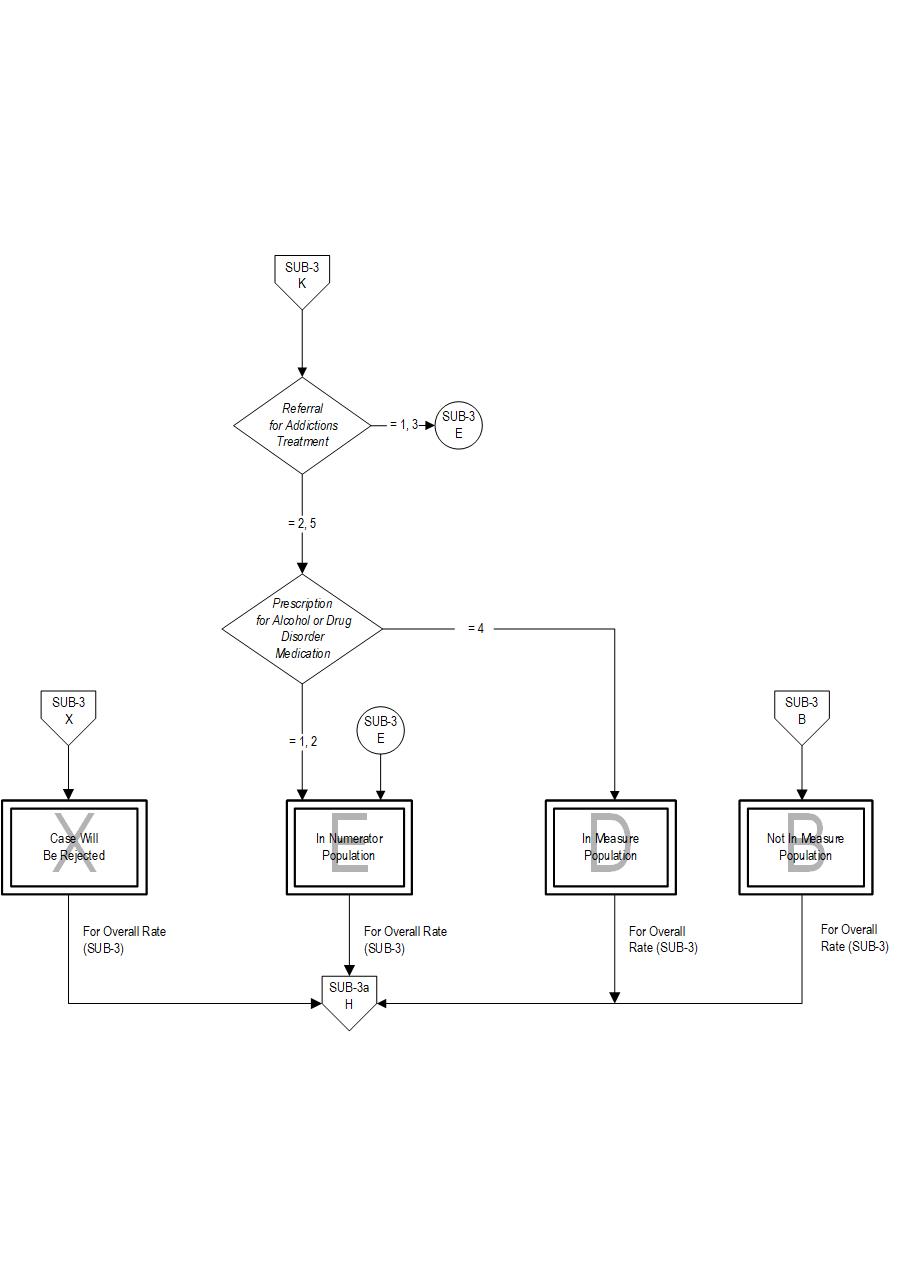
11. Check Referral for Addictions Treatment
a. If Referral for Addictions Treatment is missing, the case will proceed to a Measure Category Assignment of X for overall rate SUB-3 and will be rejected. Continue processing and proceed to Step 15 to Initialize Measure Category Assignment for sub-measure SUB-3a.
b. If Referral for Addictions Treatment equals 4, the case will proceed to a Measure Category Assignment of B for overall rate SUB-3 and will not be in the Measure Population. Continue processing and proceed to Step 15 to Initialize Measure Category Assignment for sub-measure SUB-3a.
c. If Referral for Addictions Treatment equals 1, 2, 3 or 5, continue processing and proceed to check Prescription for Alcohol or Drug Disorder Medication.
12. Check Prescription for Alcohol or Drug Disorder Medication
a. If Prescription for Alcohol or Drug Disorder Medication is missing, the case will proceed to a Measure Category Assignment of X for overall rate SUB-3 and will be rejected. Continue processing and proceed to Step 15 to Initialize Measure Category Assignment for sub-measure SUB-3a.
b. If Prescription for Alcohol or Drug Disorder Medication equals 3, the case will proceed to a Measure Category Assignment of B for overall rate SUB-3 and will not be in the Measure Population. Continue processing and proceed to Step 15 to Initialize Measure Category Assignment for sub-measure SUB-3a.
c. If Prescription for Alcohol or Drug Disorder Medication equals 1, 2 or 4, continue processing and proceed to recheck Referral for Addictions Treatment.
13. Recheck Referral for Addictions Treatment
a. If Referral for Addictions Treatment equals 1 or 3, the case will proceed to a Measure Category Assignment of E for overall rate SUB-3 and will be in the Numerator Population. Continue processing and proceed to Step 15 to Initialize Measure Category Assignment for sub-measure SUB-3a.
b. If Referral for Addictions Treatment equals 2 or 5, continue processing and proceed to recheck Prescription for Alcohol or Drug Disorder Medication.
14. Recheck Prescription for Alcohol or Drug Disorder Medication
a. If Prescription for Alcohol or Drug Disorder Medication equals 4, the case will proceed to Measure Category Assignment of D and will be in the Measure Population for the overall measure rate SUB 3. Continue processing and proceed to Step 15 to Initialize Measure Category Assignment for sub-measure SUB-3a.
b. If Prescription for Alcohol or Drug Disorder Medication equals 1 or 2, the case will proceed to a Measure Category Assignment of E and will be in the Numerator Population for the overall measure rate SUB 3. Continue processing and proceed to Step 15 to Initialize Measure Category Assignment for sub-measure SUB-3a.
Algorithm Narrative
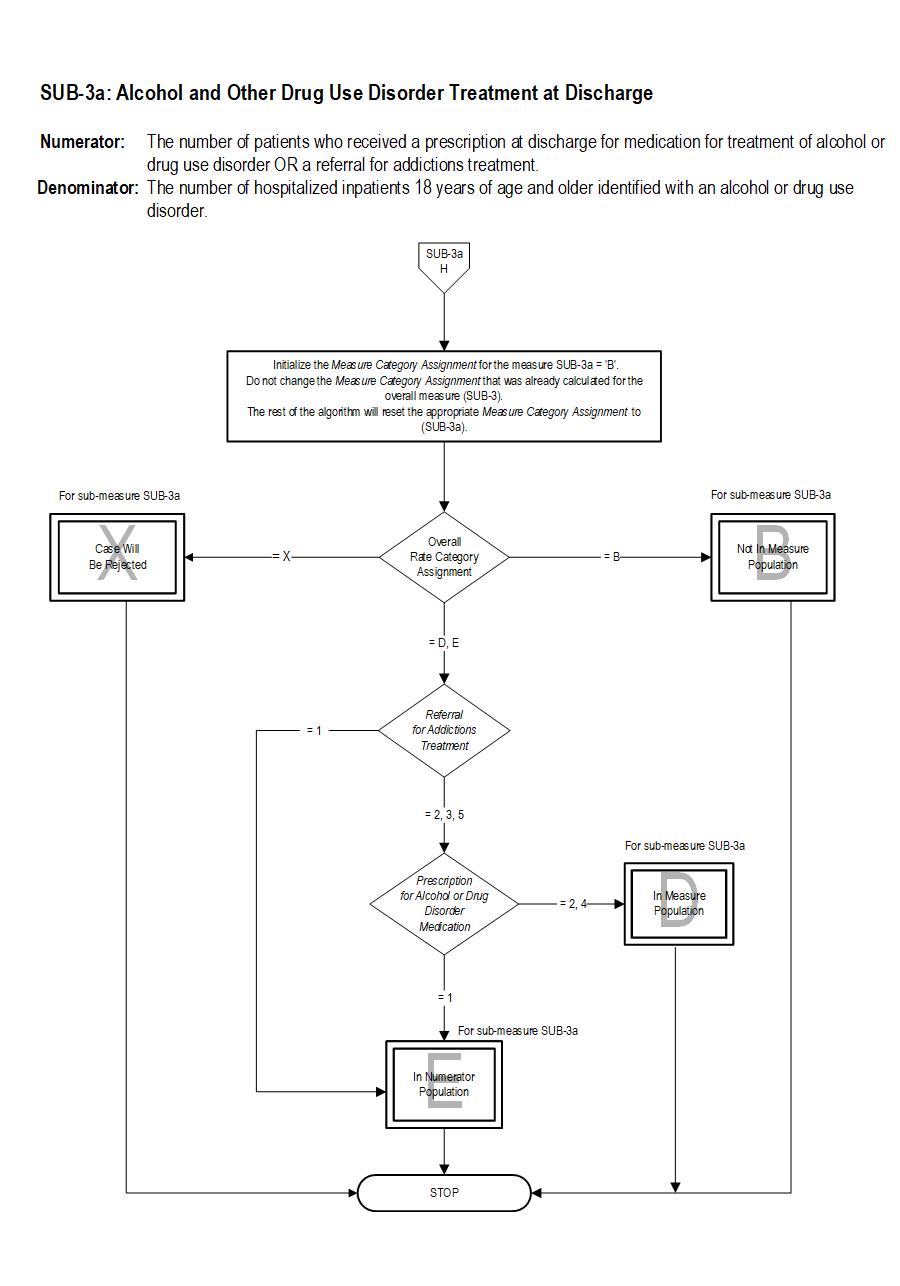
SUB-3a: Alcohol and Other Drug Use Disorder Treatment at DischargeNumerator: The number of patients who received a prescription at discharge for medication for treatment of alcohol or drug use disorder OR a referral for addictions treatment.
Denominator: The number of hospitalized inpatients 18 years of age and older identified with alcohol or drug disorder.
15. Initialize the Measure Category Assignment for the sub-measure SUB-3a to Measure Category Assignment B. Do not change the Measure Category Assignment that was already calculated for the overall measure SUB-3. The rest of the algorithm will reset the appropriate Measure Category Assignment to SUB-3a.
16. Check Overall Rate Category Assignment
a. If Overall Rate Category Assignment equals X, the case will proceed to a Measure Category Assignment of X for sub-measure SUB-3a and will not be in the Measure Population. Stop processing.
b. If Overall Rate Category Assignment equals B, the case will proceed to a Measure Category Assignment of B for sub-measure SUB-3a and will not be in the Measure Population. Stop processing
c. If Overall Rate Category Assignment equals D or E, continue processing and proceed to recheck Referral for Addictions Treatment.
17. Recheck Referral for Addictions Treatment
a. If Referral for Addictions Treatment equals 1, the case will proceed to a Measure Category Assignment of E and will be in the Numerator Population for sub-measure SUB-3a. Stop processing.
b. If Referral for Addictions Treatment equals 2, 3 or 5, continue processing and proceed to recheck Prescription for Alcohol or Drug Disorder Medication.
18. Recheck Prescription for Alcohol or Drug Disorder Medication
a. If Prescription for Alcohol or Drug Disorder Medication equals 2 or 4, the case will proceed to a Measure Category Assignment of D and will be in the Measure Population for sub-measure SUB-3a. Stop processing.
b. If Prescription for Alcohol or Drug Disorder Medication equals 1, the case will proceed to a Measure Category Assignment of E and will be in the Numerator Population for sub-measure SUB-3a. Stop processing.
LICENSE FOR USE OF CURRENT PROCEDURAL TERMINOLOGY, FOURTH EDITION (“CPT®”)
CPT® only copyright 2026 American Medical Association. All rights reserved. CPT® is a registered trademark of the American Medical Association.
You, your employees and agents are authorized to use CPT® only as contained in The Joint Commission performance measures solely for your own personal use in directly participating in healthcare programs administered by The Joint Commission. You acknowledge that the American Medical Association (“AMA”) holds all copyright, trademark and other rights in CPT®.
Any use not authorized herein is prohibited, including by way of illustration and not by way of limitation, making copies of CPT® for resale and/or license, transferring copies of CPT® to any party not bound by this Agreement, creating any modified or derivative work of CPT®, or making any commercial use of CPT®. License to use CPT® for any use not authorized herein must be obtained through the American Medical Association, Intellectual Property Services, AMA Plaza, 330 North Wabash Avenue, Suite 39300, Chicago, Illinois 60611-5885. Applications are available at the American Medical Association Web site, www.ama- assn.org/go/cpt.
U.S. Government Rights This product includes CPT® which is commercial technical data, which was developed exclusively at private expense by the American Medical Association, 330 North Wabash Avenue, Chicago, Illinois 60611. The American Medical Association does not agree to license CPT® to the Federal Government based on the license in FAR 52.227-14 (Data Rights - General) and DFARS 252.227-7015 (Technical Data - Commercial Items) or any other license provision. The American Medical Association reserves all rights to approve any license with any Federal agency.
Disclaimer of Warranties and Liabilities. CPT® is provided “as is” without warranty of any kind, either expressed or implied, including but not limited to the implied warranties of merchantability and fitness for a particular purpose. Fee schedules, relative value units, conversion factors and/or related components are not assigned by the AMA, are not part of CPT®, and the (AMA is not recommending their use. The AMA does not directly or indirectly practice medicine or dispense medical services. The responsibility for the content of this product is with The Joint Commission, and no endorsement by the AMA is intended or implied. The AMA disclaims responsibility for any consequences or liability attributable to or related to any use, non-use, or interpretation of information contained or not contained in this product.
This Agreement will terminate upon notice if you violate its terms. The AMA is a third party beneficiary to this Agreement.
Should the foregoing terms and conditions be acceptable to you, please indicate your agreement and acceptance by clicking below on the button labeled “accept”.