Measure Information Form
Version 2027A
Measure Information Form
In patients with acute ischemic stroke (AIS) and impaired mobility, intermittent pneumatic compression (IPC) or prophylactic low-dose subcutaneous heparin (UFH or LMWH) are recommended options to reduce the risk of deep vein thrombosis (DVT), unless contraindications exist. Elastic compression stockings or graduated compression stockings (GCS) are not recommended and may be harmful, resulting in skin breakdown, ulceration, and tissue necrosis (Prabhakaran, S., et al., 2026). Mechanical or pharmacological VTE prophylaxis are also recommended for patients with spontaneous intracerebral hemorrhage (ICH), (Greenberg, S., et al.,2022), and aneurysmal subarachnoid hemorrhage (aSAH) whose aneurysm has been repaired (Hoh, B., et al., 2023). Aspirin alone is not recommended as an agent to prevent VTE.
Type Of Measure: Process Improvement Noted As: Increase in the rateIncluded Populations: Not applicable Excluded Populations: None Data Elements:Denominator Statement: Ischemic or hemorrhagic stroke patients
Included Populations: Discharges with an ICD-10-CM Principal Diagnosis Code for ischemic or hemorrhagic stroke as defined in Appendix A, Table 8.1 or Table 8.2. Excluded Populations:Data Elements:
- Patients less than 18 years of age
- Patients who have a Length of Stay less than 2 days
- Patients who have a Length of Stay greater than 120 days
- Patients with Comfort Measures Only documented on day of or day after hospital arrival
- Patients enrolled in clinical trials
- Patients admitted for Elective Carotid Intervention
- Greenberg, S. M., Ziai, W. C., Cordonnier, C., Dowlatshahi, D., Francis, B., Goldstein, J. N., Hemphill, J. C., III, Johnson, R., Keigher, K. M., Mack, W. J., Mocco, J., Newton, E. J., Ruff, I. M., Sansing, L. H., Schulman, S., Selim, M. H., Sheth, K. N., Sprigg, N., & Sunnerhagen, K. S. (2022). 2022 guideline for the management of patients with spontaneous intracerebral hemorrhage: A guideline from the American Heart Association/American Stroke Association. Stroke, 53 (7), e325–e326.
- Hoh, B. L., Ko, N. U., Amin-Hanjani, S., Chou, S. H.-Y., Cruz-Flores, S., Dangayach, N. S., Derdeyn, C. P., Du, R., Hänggi, D., Hetts, S. W., Ifejika, N. L., Johnson, R., Keigher, K. M., Leslie-Mazwi, T. M., Lucke-Wold, B., Rabinstein, A. A., Robicsek, S. A., Stapleton, C. J., Suarez, J. I., … Welch, B. G. (2023). 2023 guideline for the management of patients with aneurysmal subarachnoid hemorrhage: A guideline from the American Heart Association/American Stroke Association. Stroke, 54, e321. https://doi.org/10.1161/STR.000000000000043.
- Kearon, C., Akl, E. A., Comerota, A. J., Prandoni, P., Bounameaux, H., Goldhaber, S. Z., Nelson, M. E., Wells, P. S., Gould, M. K., Dentali, F., Crowther, M., & Kahn, S. R. (2012). Antithrombotic therapy for VTE disease: Antithrombotic therapy and prevention of thrombosis, 9th ed: American College of Chest Physicians evidence-based clinical practice guidelines. Chest, 141 (2 Suppl), e419S–e496S. https://doi.org/10.1378/chest.11-2301.
- Kearon, C., Akl, E. A., Ornelas, J., Blaivas, A., Jimenez, D., Bounameaux, H., Huisman, M., King, C. S., Morris, T. A., Sood, N., Stevens, S. M., Vintch, J. R. E., Wells, P., Woller, S. C., & Moores, L. (2016). Antithrombotic therapy for VTE disease: CHEST guideline and expert panel report. Chest, 149 (2), 315–352. https://doi.org/10.1016/j.chest.2015.11.026
- Maynard, G. (2016). Preventing hospital-associated venous thromboembolism: A guide for effective quality improvement. Agency for Healthcare Research and Quality.
- Prabhakaran, S., Gonzalez, N. R., Zachrison, K. S., Adeoye, O., Alexandrov, A. W., Ansari, S. A., Chapman, S., Czap, A. L., Dumitrascu, O. M., Ishida, K., Jadhav, A. P., Johnson, B., Johnston, K. C., Khatri, P., Kimberly, W. T., Lee, V. H., Leslie-Mazwi, T. M., Mac Grory, B., Madsen, T. E., Menon, B., Mistry, E. A., Park, S., Parker, S., Pérez de la Ossa, N., Reeves, M., Saiz, T., Scott, P. A., Schwartzberg, D., Sheth, S. A., Sporns, P. B., Times, S., Tjoumakaris, S., Wolfe, S. Q., & Yaghi, S.; Peer Review Committee Collaborators. (2026). 2026 guideline for the early management of patients with acute ischemic stroke: A guideline from the American Heart Association/American Stroke Association. Stroke. Advance online publication. https://doi.org/10.1161/STR.0000000000000513
- Schünemann, H. J., Cushman, M., Burnett, A. E., Kahn, S. R., Beyer-Westendorf, J., Spencer, F. A., Rezende, S. M., Zakai, N. A., Bauer, K. A., Dentali, F., Lansing, J., Balduzzi, S., Darzi, A., Morgano, G. P., Neumann, I., Nieuwlaat, R., Yepes-Nuñez, J. J., Zhang, Y., & Wiercioch, W. (2018). American Society of Hematology 2018 guidelines for management of venous thromboembolism: Prophylaxis for hospitalized and nonhospitalized medical patients. Blood Advances, 2 (22), 3198–3225. https://doi.org/10.1182/bloodadvances.2018022954
- Stevens, S. M., Woller, S. C., Baumann Kreuziger, L., Bounameaux, H., Doerschug, K., Geersing, G.-J., Huisman, M. V., Kearon, C., King, C. S., Knighton, A. J., Lake, E., Murin, S., Vintch, J. R. E., Wells, P. S., & Moores, L. K. (2021). Executive summary: Antithrombotic therapy for VTE disease: Second update of the CHEST guideline and expert panel report. Chest, 160 (6), 2247–2259.
- Yang, Y., Chen, D., & Bhaskar, S. M. M. (2025). Incidence, risk factors, and prevention of deep vein thrombosis in acute ischemic stroke patients (IRIS-DVT study): A systematic review and meta-analysis. Clinical and Translational Neuroscience, 9 (4), 49. https://doi.org/10.3390/ctn9040049
STK-1: Algorithm Narrative
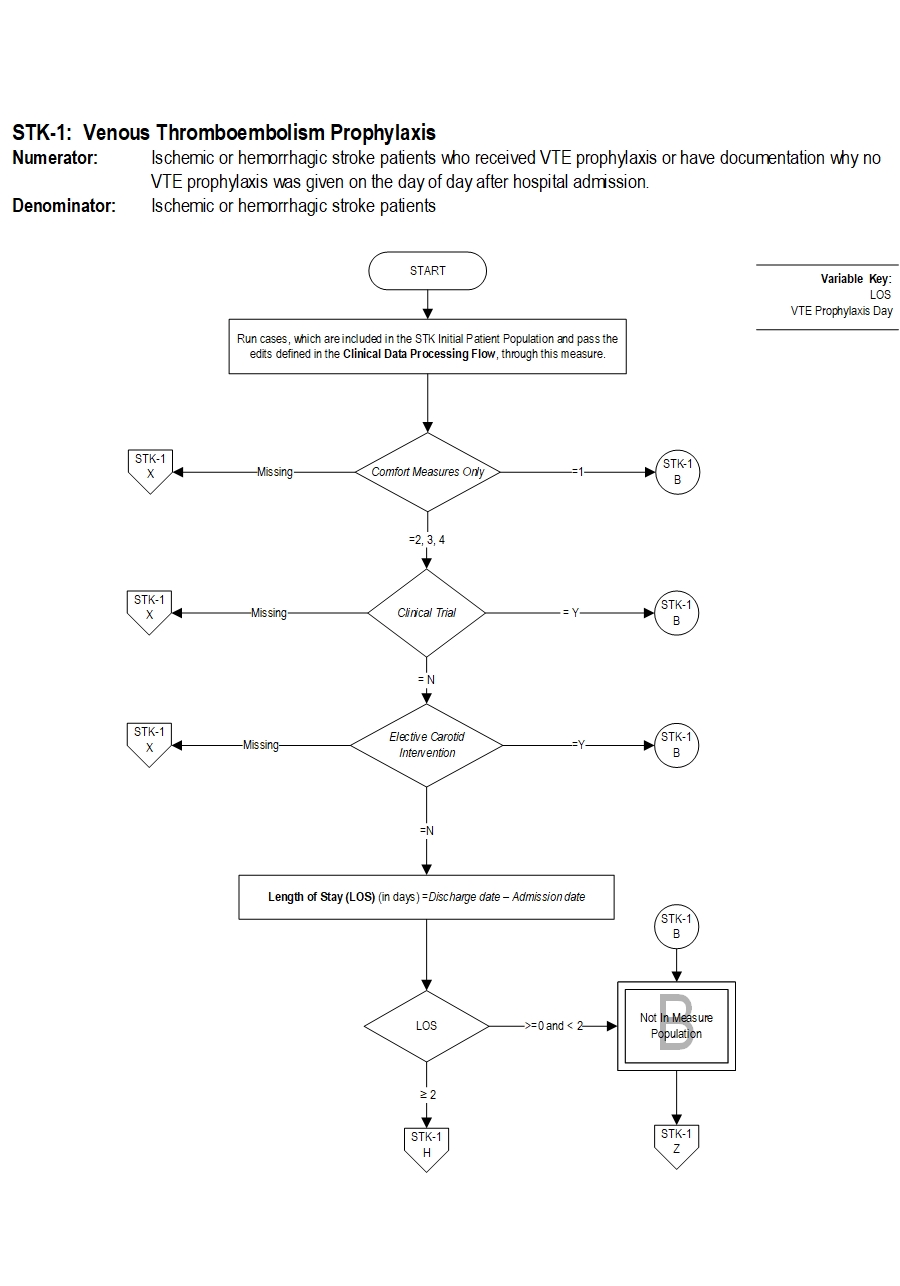
STK-1: Venous Thromboembolism Prophylaxis Numerator: Ischemic or hemorrhagic stroke patients who received VTE prophylaxis or have documentation why no VTE prophylaxis was given on the day of or day after hospital admission.
Denominator: Ischemic or hemorrhagic stroke patients.
Variable Key: LOS
VTE Prophylaxis Day
1. Start Venous Thromboembolism Prophylaxis logic. Run cases, which are included in the Stroke Initial Patient Population and pass the edits defined in the Clinical Data Processing Flow, through this measure.
2. Check Comfort Measures Only.
- If Comfort Measures Only is Missing, the case will proceed to a Measure Category Assignment of X and Case Will Be Rejected. Stop processing.
- If Comfort Measures Only equals 1, the case will proceed to Measure Category Assignment of B and will not be in the Measure Population. Stop processing.
- If Comfort Measures Only equals 2, 3, or 4, the case will continue processing and proceed to check Clinical Trial.
- If Clinical Trial is Missing, the case will proceed to a Measure Category Assignment of X and will be rejected. Stop processing.
- If Clinical Trial equals Y, the case will proceed to a Measure Category Assignment of B and will be Not In Measure Population. Stop processing.
- If Clinical Trial equals N, the case will continue processing and proceed to Check Elective Carotid Intervention.
- If Elective Carotid Intervention is Missing, the case will proceed to a Measure Category Assignment of X and will be rejected. Stop processing.
- If Elective Carotid Intervention equals Y, the case will proceed to a Measure Category Assignment of B and will be Not In Measure Population. Stop processing.
- If Elective Carotid Intervention equals N, the case will continue processing and calculate Length of Stay (LOS).
- Length of Stay (LOS) (in days) equals Discharge Date minus Admission Date. Continue processing and proceed to check length of stay (LOS).
- If Length of Stay is greater than or equal to 0 and less than 2 days, the case will proceed to a Measure Category Assignment of B and will be Not In Measure Population. Stop processing.
- If Length of Stay is greater than or equal to 2 days the case will continue processing and proceed to check VTE Prophylaxis.
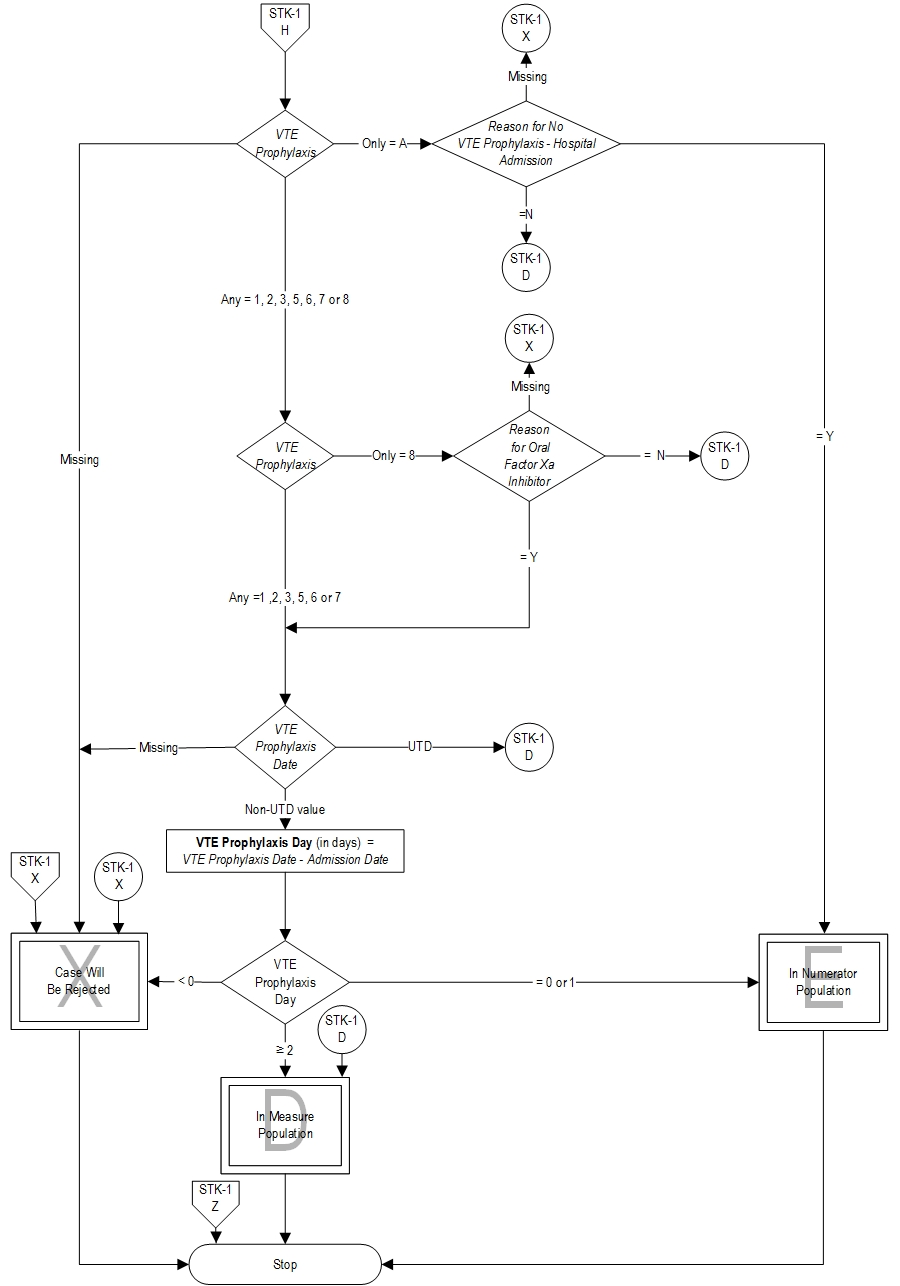
- If VTE Prophylaxis is Missing, the case will proceed to a Measure Category Assignment of X and will be rejected. Stop processing.
- If VTE Prophylaxis equals Only A, the case will continue processing and proceed to Step 8, Reason for No VTE Prophylaxis - Hospital Admission.
- If VTE Prophylaxis equals Any 1, 2, 3, 5, 6, 7 or 8 the case will continue processing and proceed to Step 9, VTE Prophylaxis.
- If Reason for No VTE Prophylaxis - Hospital Admission is Missing, the case will proceed to a Measure Category Assignment of X and will be rejected. Stop processing.
- If Reason for No VTE Prophylaxis - Hospital Admission is N, the case will proceed to Measure Category Assignment equal to D, In Measure Population, Stop Processing.
- If Reason for No VTE Prophylaxis - Hospital Admission is Y, the case will proceed to Measure Category Assignment equal to E, In Numerator Population, Stop Processing.
- If VTE Prophylaxis equals Any 1, 2, 3, 5, 6, or 7, the case will continue processing and proceed to Step 11, VTE Prophylaxis Date.
- If VTE Prophylaxis equals Only 8, the case will continue processing and proceed to Step 10, Reason for Oral Factor Xa Inhibitor.
- If Reason for Oral Factor Xa Inhibitor is Missing, the case will proceed to a Measure Category Assignment of X and will be rejected. Stop processing.
- If Reason for Oral Factor Xa Inhibitor is N, the case will proceed to Measure Category Assignment equal to D, In Measure Population. Stop Processing.
- If Reason for Oral Factor Xa Inhibitor is Y, the case will continue processing and proceed to VTE Prophylaxis Date.
- If VTE Prophylaxis Date is Missing, the case will proceed to a Measure Category Assignment of X and will be rejected. Stop processing.
- If VTE Prophylaxis Date is unable to determine (UTD), the case will proceed to Measure Category Assignment equal to D, In Measure Population. Stop Processing.
- If VTE Prophylaxis Date is Non unable to determine (UTD) value, the case will continue processing and proceed to calculate VTE Prophylaxis Day.
- VTE Prophylaxis Day (in days) equals VTE Prophylaxis Date minus Admission Date.
- Proceed to check VTE Prophylaxis Day.
- If VTE Prophylaxis Day is less than zero, the case will proceed to a Measure Category Assignment of X and will be rejected. Stop processing.
- If VTE Prophylaxis Day is greater than or equal to 2, the case will proceed to a Measure Category Assignment of D, In Measure Population. Stop processing.
- If VTE Prophylaxis Day is greater than 0 or equal to 1, the case will proceed to a Measure Category Assignment of E, In Numerator Population. Stop processing.
LICENSE FOR USE OF CURRENT PROCEDURAL TERMINOLOGY, FOURTH EDITION (“CPT®”)
CPT® only copyright 2026 American Medical Association. All rights reserved. CPT® is a registered trademark of the American Medical Association.
You, your employees and agents are authorized to use CPT® only as contained in The Joint Commission performance measures solely for your own personal use in directly participating in healthcare programs administered by The Joint Commission. You acknowledge that the American Medical Association (“AMA”) holds all copyright, trademark and other rights in CPT®.
Any use not authorized herein is prohibited, including by way of illustration and not by way of limitation, making copies of CPT® for resale and/or license, transferring copies of CPT® to any party not bound by this Agreement, creating any modified or derivative work of CPT®, or making any commercial use of CPT®. License to use CPT® for any use not authorized herein must be obtained through the American Medical Association, Intellectual Property Services, AMA Plaza, 330 North Wabash Avenue, Suite 39300, Chicago, Illinois 60611-5885. Applications are available at the American Medical Association Web site, www.ama- assn.org/go/cpt.
U.S. Government Rights This product includes CPT® which is commercial technical data, which was developed exclusively at private expense by the American Medical Association, 330 North Wabash Avenue, Chicago, Illinois 60611. The American Medical Association does not agree to license CPT® to the Federal Government based on the license in FAR 52.227-14 (Data Rights - General) and DFARS 252.227-7015 (Technical Data - Commercial Items) or any other license provision. The American Medical Association reserves all rights to approve any license with any Federal agency.
Disclaimer of Warranties and Liabilities. CPT® is provided “as is” without warranty of any kind, either expressed or implied, including but not limited to the implied warranties of merchantability and fitness for a particular purpose. Fee schedules, relative value units, conversion factors and/or related components are not assigned by the AMA, are not part of CPT®, and the (AMA is not recommending their use. The AMA does not directly or indirectly practice medicine or dispense medical services. The responsibility for the content of this product is with The Joint Commission, and no endorsement by the AMA is intended or implied. The AMA disclaims responsibility for any consequences or liability attributable to or related to any use, non-use, or interpretation of information contained or not contained in this product.
This Agreement will terminate upon notice if you violate its terms. The AMA is a third party beneficiary to this Agreement.
Should the foregoing terms and conditions be acceptable to you, please indicate your agreement and acceptance by clicking below on the button labeled “accept”.